20 Months After LASIK, Severe Dry Eye Pain Persisted. Then Things Began to Change.
How one patient’s experience with post-LASIK dry eye, meibomian gland dysfunction, IPL therapy, and specialty scleral lenses highlights the importance of individualized care.
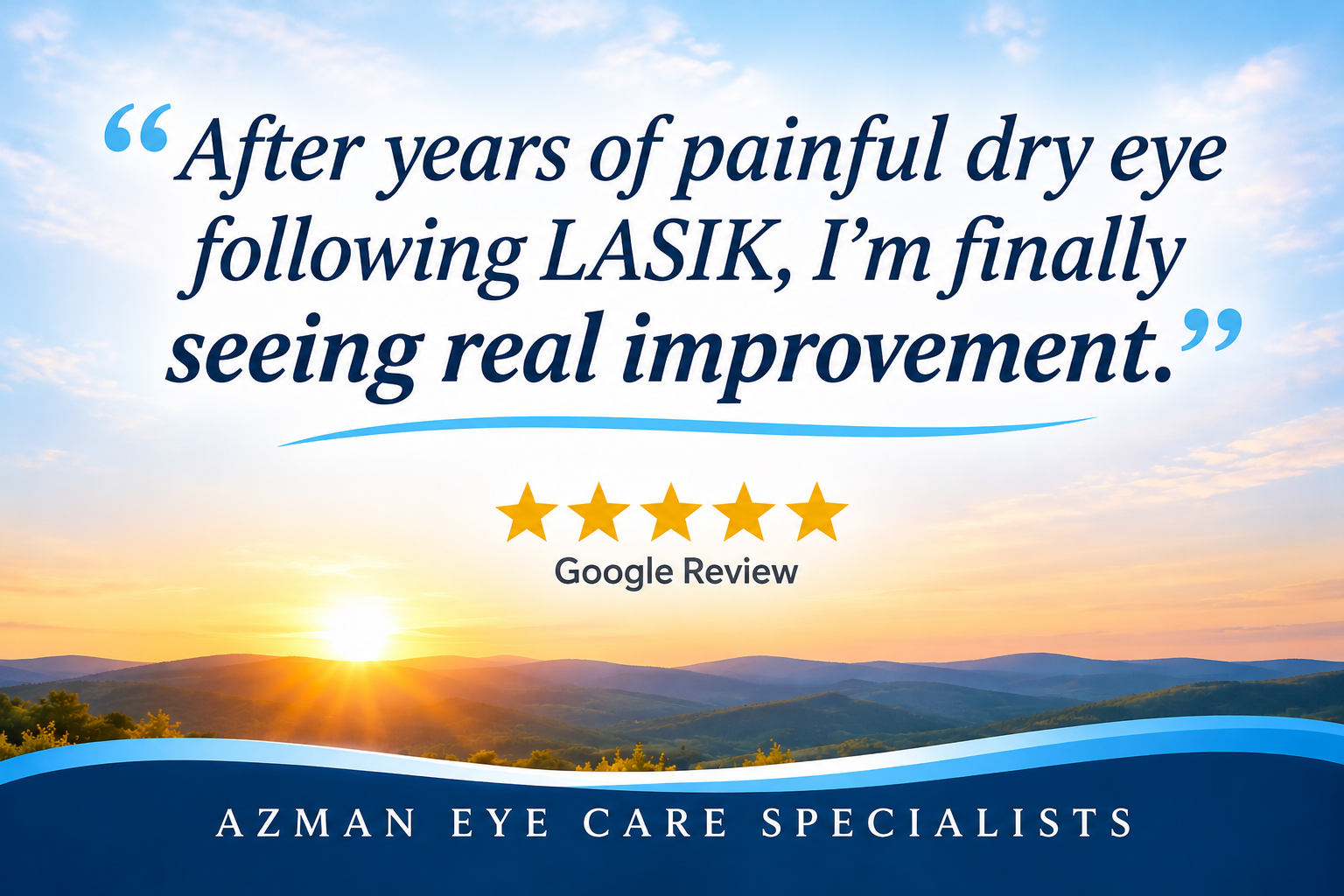
For many people, LASIK represents the possibility of clearer vision and greater freedom from glasses or contact lenses.
But what happens when the months pass, and instead of enjoying comfortable vision, you’re still struggling with painful, burning eyes and visual disturbances?
What happens when the discomfort begins interfering with your ability to work, concentrate, and get through an ordinary day?
For one patient who came to Azman Eye Care Specialists in Baltimore County, Maryland, these were more than hypothetical questions.
Twenty months after LASIK surgery, the patient was still experiencing severe, painful dry eye and visual complications.
Their experience, shared in a detailed Google review, offers an important perspective on the challenges of persistent dry eye after refractive surgery—and what can happen when treatment is tailored to the underlying causes rather than symptoms alone.
When Dry Eye After LASIK Doesn’t Go Away
Some dryness and irritation are common during the early recovery period following LASIK. For many patients, these symptoms improve over time.
For others, however, dry eye symptoms can persist for months or even longer.
Post-LASIK dry eye can involve changes in corneal nerve function, tear production, tear film stability, and inflammation of the ocular surface. In some patients, preexisting or newly recognized meibomian gland dysfunction (MGD) may also contribute to ongoing discomfort.
Symptoms can include:
- Persistent burning, stinging, or painful eyes
- A gritty or foreign-body sensation
- Fluctuating or blurry vision
- Light sensitivity and glare
- Difficulty tolerating prolonged screen use
- Excessive tearing despite feeling dry
- Discomfort that interferes with work and daily activities
The experience can be particularly frustrating when vision and comfort don’t improve as expected.
For this patient, the symptoms were severe enough that finding meaningful relief had become a priority.
A Comprehensive Evaluation That Looked Beyond the Symptoms
After finding Dr. Azman, the patient underwent a thorough evaluation of the ocular surface, meibomian glands, and visual concerns.
The patient later wrote:
“Dr. Azman is a wonderful, first-rate practitioner: a true healer who listens to his patients and wants to achieve the best possible outcomes for them.”
That opening statement reflects something important about the experience: the patient valued not only the treatments recommended but also the time spent understanding the problem.
Chronic dry eye is not a single condition with a single cause.
Two patients may experience similar burning, irritation, and blurry vision while having very different underlying problems.
A specialized dry eye evaluation may assess tear film quality, meibomian gland function, eyelid inflammation, ocular surface health, and other factors contributing to symptoms.
For patients who continue experiencing discomfort after LASIK, this type of assessment can help distinguish between different sources of dryness and visual disturbance.
Understanding Meibomian Gland Dysfunction After LASIK
One of the conditions identified in this patient’s review was meibomian gland dysfunction, commonly called MGD.
The meibomian glands are located along the upper and lower eyelids. They produce an oily component of the tear film that helps slow tear evaporation.
When these glands become obstructed or function poorly, tears may evaporate too quickly, leaving the ocular surface inadequately protected.
This is known as evaporative dry eye.
MGD may contribute to:
- Burning and irritation
- Unstable or fluctuating vision
- Redness and inflammation
- Increased sensitivity to environmental conditions
- Difficulty maintaining comfortable vision during prolonged visual tasks
MGD can coexist with other causes of post-LASIK dry eye, making it important to evaluate the entire ocular surface rather than assuming every symptom has the same origin.
For this patient, addressing meibomian gland dysfunction became part of a broader, individualized treatment strategy.
A Personalized Treatment Plan: IPL Therapy, Anti-Inflammatory Drops, and Scleral Lenses
Following the evaluation, Dr. Azman recommended a course of Intense Pulsed Light (IPL) therapy and anti-inflammatory eye drops to address the patient’s dry eye and meibomian gland dysfunction.
As treatment progressed, specialty scleral lenses were added to help manage persistent burning and discomfort.
Each approach served a different purpose.
IPL Therapy for Dry Eye and Meibomian Gland Dysfunction
Intense Pulsed Light therapy uses controlled pulses of light applied to the skin around the eyes.
In appropriately selected patients, IPL may help address inflammatory processes associated with certain forms of dry eye and meibomian gland dysfunction.
Certain IPL systems have FDA authorization for specific dry eye indications. The appropriateness of IPL depends on the patient’s diagnosis, medical history, skin characteristics, and other clinical considerations.
IPL is not a universal treatment for every form of dry eye, and results vary.
For this patient, it was one component of a more comprehensive treatment plan.
Anti-Inflammatory Eye Drops
Inflammation can contribute to ocular surface discomfort and tear film instability.
Prescription anti-inflammatory eye drops may be recommended when inflammation is contributing to dry eye symptoms.
The specific medication and duration of treatment depend on the patient’s findings and response.
Specialty Scleral Lenses for Severe Dry Eye
Scleral lenses are larger-diameter, specially designed contact lenses that vault over the cornea and rest on the sclera, the white portion of the eye.
Unlike conventional contact lenses, scleral lenses create a fluid-filled reservoir between the lens and the corneal surface.
For some patients with severe ocular surface disease, this reservoir can help protect the cornea, maintain hydration, and improve comfort. Scleral lenses may also help correct certain visual irregularities.
In the patient’s own words:
“Along the way, we added scleral lenses to help settle my burning eyes, which allowed me to work with minimal discomfort.”
That detail is especially meaningful.
For someone experiencing severe dry eye, improvement isn’t always measured only by a clinical test or a change in symptoms. Sometimes, it’s the ability to get through a workday without constant discomfort.
Three Months Later: Encouraging Progress, With Treatment Still Ongoing
One of the most compelling parts of this patient’s review is the update shared three months after the initial visit.
The patient wrote:
“Now, three months after first seeing Dr. Azman, my treatment is far from over, but I have seen excellent results: pain has receded to almost zero, and dryness-related visual symptoms are starting to improve.”
The patient was careful to explain that treatment was not complete.
There were still questions about which visual symptoms might remain after the dry eye had been more fully addressed, and whether some issues were related to LASIK itself.
This distinction matters.
Improvement in dry eye symptoms does not necessarily mean every post-LASIK visual complication has been resolved.
Persistent visual symptoms can have multiple causes, and additional assessment may be necessary even after ocular surface comfort improves.
Nevertheless, the patient’s reported progress was substantial: pain had nearly disappeared, dryness-related visual symptoms were beginning to improve, and specialty scleral lenses had helped make working more comfortable.
These are the patient’s individual results, not a prediction of what every patient will experience.
What Made the Biggest Impression? The Time and Personal Attention
Although the review describes several treatments and meaningful symptom improvement, it also emphasizes something less technical: the relationship between the patient and the doctor.
The patient explained that Dr. Azman had spent many hours discussing their care, both in person and through email.
They wrote:
“But I know that Dr. Azman is considering every possible option to address my issues; he has spent many hours with me indvidually discussing my care, in person and over email.”
For patients dealing with complex or persistent symptoms, that level of communication can be particularly important.
Dry eye management may require multiple visits, adjustments to treatment, and ongoing evaluation as symptoms change.
Patients also need opportunities to ask questions, understand their diagnosis, and discuss concerns about their vision and quality of life.
The review concluded with an especially powerful observation:
“His practice is the polar opposite of the volume-based treatment you find elsewhere. Dr. Azman provides gold-standard patient-centered care in the finest traditions of medicine.”
Those are the patient’s words, and they speak to an aspect of healthcare that can be difficult to quantify: feeling that your concerns are being taken seriously and that your care is being thoughtfully managed.
Why Persistent Dry Eye After LASIK May Require Specialized Care
LASIK can be successful at correcting refractive errors while a patient still experiences ocular surface symptoms afterward.
Persistent dry eye may involve several overlapping factors, including tear film instability, inflammation, altered corneal sensation, and meibomian gland dysfunction.
Because these factors can interact, patients who have not experienced adequate relief with conventional approaches may benefit from a more detailed assessment.
A comprehensive evaluation can help answer questions such as:
- Is the problem primarily insufficient tear production, excessive evaporation, or a combination?
- Are the meibomian glands functioning properly?
- Is ocular surface inflammation contributing to discomfort?
- Could corneal nerve-related symptoms be involved?
- Would protective specialty lenses be appropriate?
- Are visual symptoms related to tear film instability, residual refractive error, corneal irregularity, or another cause?
Not every patient will need IPL therapy, prescription anti-inflammatory drops, or scleral lenses.
The goal is to identify which treatments are appropriate for the individual’s clinical findings and needs.
Specialized Dry Eye Care in Baltimore County, Maryland
At Azman Eye Care Specialists, our approach to complex dry eye begins with understanding the patient’s symptoms, ocular surface findings, and the impact the condition is having on everyday life.
Our practice evaluates patients with persistent dry eye, meibomian gland dysfunction, ocular surface inflammation, and complex visual concerns, including symptoms that may occur following LASIK or other refractive procedures.
Treatment recommendations are individualized and may include in-office therapies, prescription medications, specialty contact lenses, and ongoing management.
Located at 1427 Clarkview Road, Suite 200, Baltimore, MD 21209, our office serves patients from Towson, Pikesville, Lutherville, Timonium, and communities throughout Baltimore County and Maryland.
For patients who have spent months or years searching for answers, a comprehensive evaluation may help identify additional treatment options.
Frequently Asked Questions About Dry Eye After LASIK
1. Can severe dry eye develop or persist long after LASIK surgery?
Yes. Although temporary dry eye is common after LASIK and often improves during recovery, some patients experience persistent symptoms for months or longer. Changes in corneal nerve function, tear production, tear film stability, and preexisting ocular surface conditions may contribute. Persistent symptoms warrant a thorough eye examination to identify possible causes.
2. What is the connection between LASIK and meibomian gland dysfunction?
LASIK does not necessarily cause meibomian gland dysfunction (MGD), but the two conditions can coexist. MGD affects the oil-producing glands in the eyelids and may cause tears to evaporate too quickly. In someone already experiencing post-LASIK ocular surface symptoms, MGD can contribute to additional dryness, burning, and fluctuating vision. Identifying and treating MGD may be an important part of managing symptoms.
3. Can IPL therapy help with chronic dry eye after LASIK?
IPL therapy may be helpful for certain patients whose dry eye symptoms involve meibomian gland dysfunction or related inflammation. However, IPL does not directly reverse all possible effects of LASIK, and it is not appropriate for every patient. A specialized evaluation can help determine whether IPL is a suitable component of an individualized treatment plan.
4. How do scleral lenses help patients with severe dry eye?
Scleral lenses vault over the cornea and maintain a fluid reservoir between the lens and the eye. This can help protect and hydrate the ocular surface, potentially improving comfort for patients with severe dry eye. They may also improve vision in patients with certain corneal irregularities. Proper fitting and ongoing follow-up are important.
5. Why is my vision still blurry or fluctuating after LASIK?
Blurred or fluctuating vision after LASIK can have several causes, including an unstable tear film, dry eye disease, residual refractive error, corneal irregularities, or other ocular conditions. Dry eye treatment may improve symptoms related to tear film instability, but it may not resolve every visual issue. A comprehensive examination is needed to identify the contributing factors.
6. When should I see a specialist for persistent dry eye after LASIK?
Consider a specialized evaluation if you continue experiencing burning, pain, redness, light sensitivity, or fluctuating vision despite using artificial tears or other recommended treatments. Symptoms that interfere with work, reading, screen use, or everyday activities also deserve further investigation. Severe pain or a sudden change in vision requires prompt medical assessment.
7. Where can I find specialized treatment for post-LASIK dry eye in Maryland?
Azman Eye Care Specialists provides evaluation and individualized treatment for chronic dry eye, meibomian gland dysfunction, and complex ocular surface concerns, including persistent symptoms following LASIK. The practice is located in Baltimore County at 1427 Clarkview Road, Suite 200, Baltimore, MD 21209. Treatment options depend on each patient’s examination findings and needs.
Still Struggling With Dry Eye After LASIK?
If you’re experiencing persistent burning, irritation, painful dry eyes, or fluctuating vision months or years after LASIK, you may benefit from a more comprehensive evaluation.
Understanding the underlying causes of your symptoms is an important step toward determining which treatment options may be appropriate.
At Azman Eye Care Specialists, we work with patients experiencing complex dry eye and ocular surface conditions to develop individualized approaches to care.
Azman Eye Care Specialists
1427 Clarkview Road, Suite 200
Baltimore, MD 21209
Phone: 410-469-7111
Website: https://www.azmaneye.com/
Read the patient’s original Google review:
https://maps.app.goo.gl/9wAmmhF4D6PWTUKJA
Patient experiences are individual. The results described in this article reflect one patient’s reported progress and do not guarantee similar outcomes. Diagnosis and treatment recommendations require an individualized examination.